Category: Uncategorized

  • Postdoctoral positions in Helsinki

    Applications are invited for up to two postdoctoral researcher positions at the University of Helsinki, Finland, in a project led by Academy Research Fellow Tuomo Salmi. The selected researchers are expected to perform cutting-edge research in connecting plasma astrophysics and X-ray observations to constrain neutron star physics. Depending on the applicant’s interests and expertise, the research may involve neutron-star atmosphere and magnetosphere modelling, mapping the surface emission of millisecond pulsars, and/or constraining the equation of state of ultradense matter. Experience in numerical simulations, theoretical neutron star astrophysics, radiative-transfer or pulse-profile modelling, and X-ray data analysis are considered beneficial. The research can be performed in collaboration with a wide group of researchers in the Centre of Excellence in Neutron-Star Physics.

    Application process: The appointments will be for 2 years. The starting date is negotiable, although starting before the end of 2026 is required for one of the positions. A later starting date is possible for the other position, but a start no later than early 2027 is preferred. Applicants are expected to hold a Ph.D. in astrophysics, plasma physics, computational physics, or a related field by the start date. Application materials should include: 

    • CV 
    • List of publications (incl. papers and possible scientific software developed)
    • Research statement (maximum 3 pages) summarizing past research achievements and outlining the planned research program 
    • 3 reference letters, to be submitted separately and directly by the referees.

    Applicants should send their CV, publication list, and research statement as a single PDF file to the following link by 31st of August, 2026: Applications

    The reference letters should be sent separately and directly by the referees using the following link by the same deadline: Reference Letters

    Alternatively, applicants may send their application materials, and referees their reference letters, by email to <tuomo.salmi@helsinki.fi>.

    Helsinki: Finland has been selected as the happiest country nine times in a row and is one of the safest locations worldwide. We enjoy beautiful nature and the cleanest air in the world. Helsinki is an international city, known for its architecture and design, packed with diverse cultural and recreational activities and outstanding services for families and children. We are committed to fostering equality, diversity, inclusion, and workplace well-being.

    Compensation and Benefits: The annual salary will be approximately 45,000–50,000 EUR, including comprehensive occupational health care. The position offers generous travel funds, opportunities to work with top physics students, and access to exceptional computing resources. In addition, the position includes five weeks of paid vacation per year, paid sick leave, and paid parental leave.


    Further Info:

    Tuomo Salmi (<tuomo.salmi@helsinki.fi>)

    P.O. Box 64
    FI-00014 University of Helsinki
    Finland

  • ERC Advanced Grant awarded for research on quark matter and neutron stars

    ERC Advanced Grant awarded for research on quark matter and neutron stars

    Professor Aleksi Vuorinen, Director of the Centre of Excellence in Neutron Star Physics, has been awarded a prestigious European Research Council (ERC) Advanced Grant for his project StellarQCD. The five-year project, hosted by the Helsinki Institute of Physics at the University of Helsinki, will investigate the properties of matter at densities far beyond those found in atomic nuclei and explore whether massive neutron stars may contain cores of deconfined quark matter.

    The project combines theoretical calculations within thermal field theory with the systematic exploitation of astrophysical observations to improve our understanding of dense Quantum Chromodynamics (QCD) matter. A central goal here is to determine how the presence of quark matter could manifest itself in neutron-star observations, including gravitational waves emitted during neutron-star mergers. This makes the project closely aligned with Themes 1 (Neutron-Star Interiors) and 4 (Neutron-Star Mergers) of the CoE.

    The ERC Advanced Grant is among the most competitive funding instruments in Europe and supports ambitious, high-risk, high-gain research led by established investigators. The grant demonstrates Finland’s internationally recognised status in neutron-star physics and further strengthens the Centre of Excellence’s activities in the field of dense QCD matter.

    Read the University of Helsinki press release here.

    Read the ERC press release here.

  • Physics of Neutron Stars

    Physics of Neutron Stars

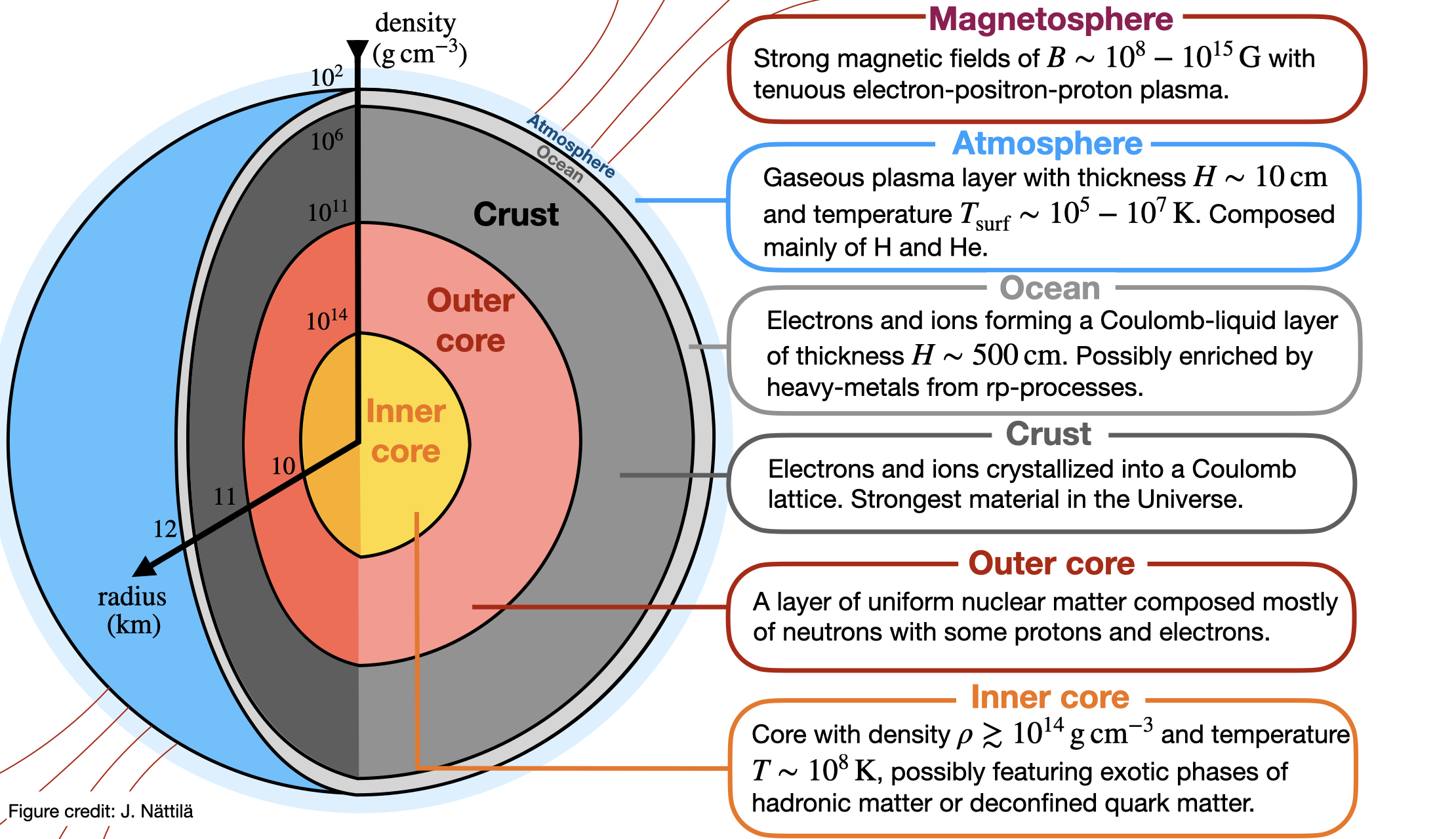
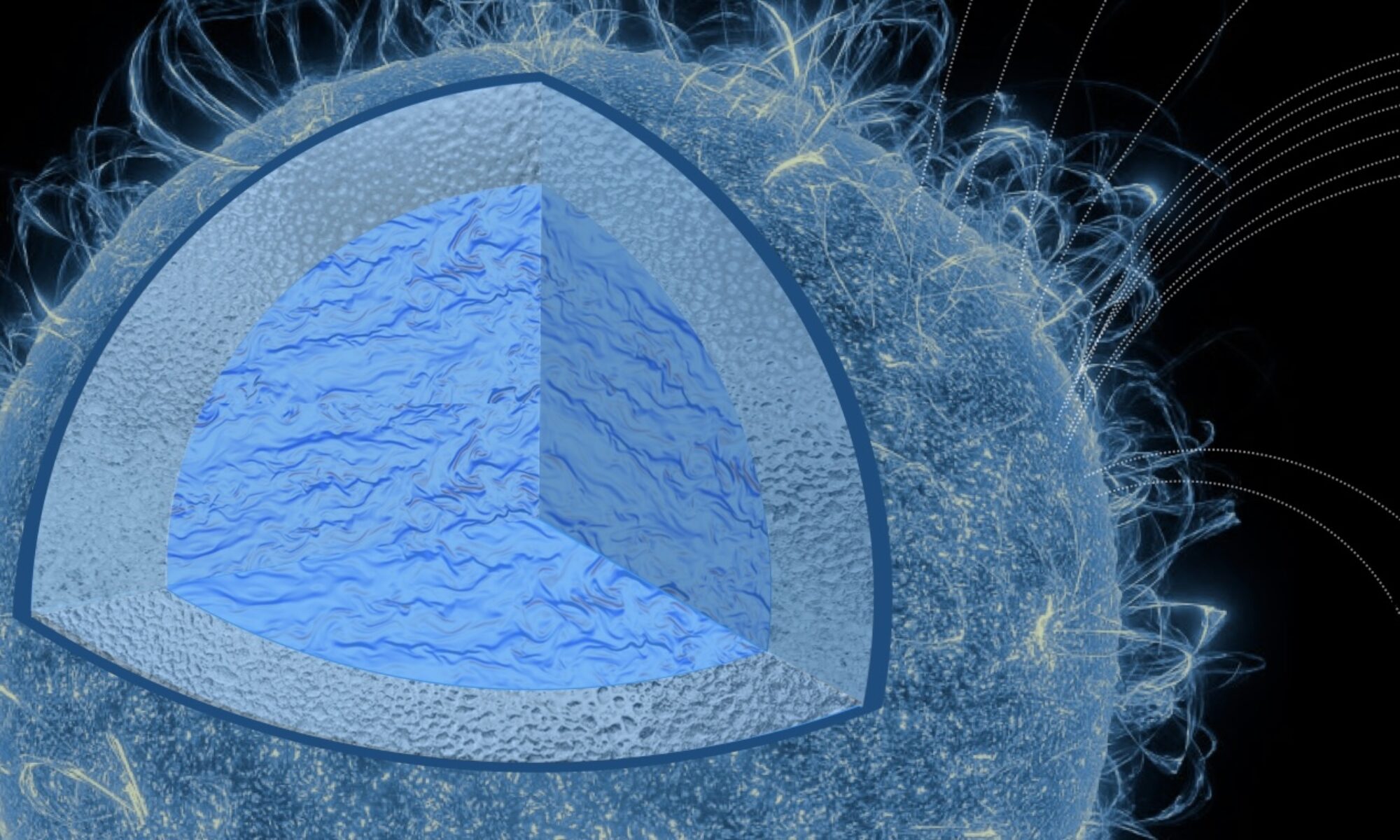
    With core densities exceeding the nuclear saturation density manyfold and magnetars hosting magnetic fields reaching tens of Schwinger fields, these exotic objects serve as unique laboratories for dense nuclear matter, relativistic plasmas, and strong gravity. A quantitative understanding of NSs and their binary mergers is indeed expected to hold the key to solving several fundamental-physics mysteries from the structure of the Quantum Chromodynamics phase diagram to the origin of heavy elements and fast radio bursts.

    Today, we are witnessing the dawn of a new precision era in NS physics. The quality and quantity of observational data are expected to dramatically increase with third-generation gravitational-wave observatories and planned X-ray missions, such as the Einstein Telescope, IXPE and eXTP, while new data on exotic nuclei will be available with state-of-the-art nuclear-physics instruments and laboratories. Add to this recent breakthroughs in ab-initio calculations and improvements in computational facilities, both increasing the accuracy of numerical simulations, now is the time to address the next-generation problems of NS physics.